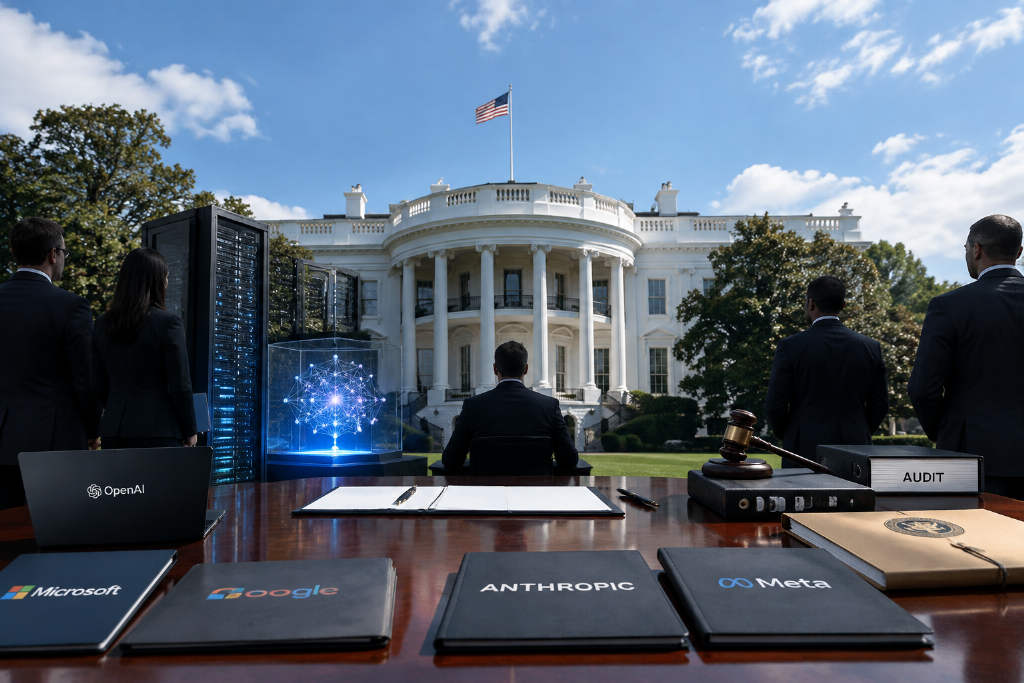
Donald Trump2026-09-30 00:28:38Trump signs voluntary frontier AI accord that puts self-policing burden on tech firmsUS President Donald Trump and a group of top technology executives signed a voluntary White House accord aimed at making sure advanced AI models behave as intended. The agreement, titled Joint Commitment on Frontier Responsibilities, places much of the burden for managing frontier AI risks on the companies building those systems rather than on immediate federal restrictions. The accord calls for internal controls, independent external audits and board-level oversight to ensure models do not hack or access technical systems in unintended ways. It also leaves open the option of turning those commitments into law or regulation over time. Trump said at the White House that he was seeing strong self-policing from the companies and that they understood they had to police themselves. The signatories included Google CEO Sundar Pichai, Anthropic CEO Dario Amodei, Meta CEO Mark Zuckerberg, OpenAI President Greg Brockman, Nvidia CEO Jensen Huang and xAI CEO Elon Musk. The White House meeting also covered AI safety, industry growth and data center development. Trump separately ruled out a US-China joint venture to develop AI and, on the same day, signed an executive order directing the executive branch to use the term “Super Intelligence” instead of “Artificial Intelligence.”290
David Sacks2026-09-14 05:22:32David Sacks attacks calls to pace frontier AI, as Sam Altman says trust should not wait for antitrust reliefDavid Sacks, co-chair of the President’s Council of Advisors on Science and Technology and a former White House AI and crypto czar, publicly pushed back against calls by Anthropic CEO Dario Amodei and OpenAI CEO Sam Altman to slow the pace of frontier AI development. In a post on X, Sacks argued that OpenAI and Anthropic are themselves the frontier and said that if they believe development should slow, they can do it on their own rather than tie that decision to outside permissions, regulatory carve-outs, or antitrust exemptions. His critique focused on the conditions surrounding the slowdown debate. Sacks said companies should stop pretending they need permission from others, stop implying antitrust law must be suspended to let a small group coordinate, and stop presenting certain evaluators as independent when, in his view, those relationships are intertwined. He also pointed to product liability and market discipline, arguing that safer and more predictable systems can also be a business decision. Altman responded the next day in two long posts. Without naming Sacks, he said OpenAI supports a federal framework for consistent frontier AI safety standards, but argued that building public trust should begin now and does not require waiting for antitrust relief or new legislation. He also said pacing does not mean stopping, and warned against two outcomes: handing humanity’s future control to AI, or allowing too much power to concentrate in one person, company, or country.910
Anthropic2026-09-13 09:27:00Anthropic CEO Dario Amodei urges slower pace for frontier AI in three-step planAnthropic co-founder and CEO Dario Amodei has called for a slower pace in advancing frontier AI models, arguing that safety alignment and regulation need more time to catch up. In a post laying out a three-step proposal titled "pacing the frontier," Amodei said recursive self-improvement is already appearing inside the industry. Without controls, he warned, multi-agent "swarms" could within the next 6 to 12 months gain the ability to cause catastrophic damage through large-scale cyberattacks and persistent botnets. His proposal includes bringing in third-party embedded evaluation bodies with ongoing access at an employee level, coordinating capability and safety standards among frontier AI companies in democratic countries with government backing, and seeking global coordination with countries including China on issues such as biological weapons, cybersecurity testing, and the speed of recursive self-improvement. The framework, as described, would still preserve the technological lead of the United States and its allies while trying to set limits in several high-risk areas.830
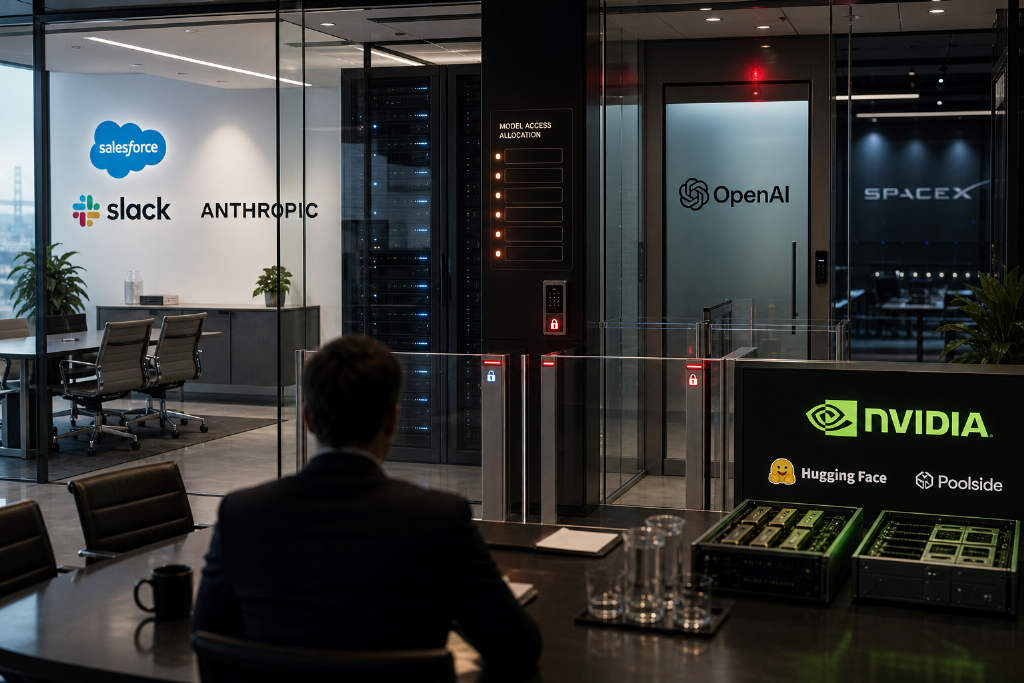
AI2026-09-01 04:27:30VC Says Access, Not Price, Is the New Scarcity as Frontier AI Splits Into Closed CampsIn a post on X, venture capitalist Tomasz Tunguz said the frontier AI market is splitting into closed camps, with labs choosing partners, cutting off rivals and rationing access to top models. He pointed to recent moves across partnerships, API cutoffs and model rationing as evidence. Salesforce has tapped Anthropic as its dedicated AI partner, making Claude the default model in the world's largest CRM and Slack. OpenAI cut Cursor's API access on Nov. 12 after SpaceX acquired Cursor. Z.ai has put its flagship model behind the security review of a host with cumulative revenue over $10 billion. Anthropic is rationing Mythos 5 via Project Glasswing and restricting Fable to U.S.-only inference. OpenAI is giving trusted partners early access to GPT-5.6 variants. On the investment side, Nvidia is backing open ecosystems with $13 billion for Hugging Face, $7 billion for Poolside and $26 billion for Nemotron. Tunguz argues that access, not price, is the new scarcity in frontier AI.810
AI regulation2026-08-12 23:40:41White House Plans to Expand AI Regulation, Open-Source Models Could Face Pre-Release TestingBlockBeats, citing WIRED, reported on August 13 that the Trump administration is revising its newly crafted artificial intelligence guidelines and will expand regulation of AI models. The report, which is based on information from people familiar with the matter, says the White House has established an AI framework this month. Under that framework, frontier AI models developed by U.S. labs must undergo federal safety tests before being publicly released. The government has not made the framework public, and there are reportedly no plans to do so. For now, the framework applies only to so-called closed-source models developed by companies such as Anthropic and OpenAI. However, a White House official said the framework is expected to also cover open-source models in the coming months. In short, once an open-source model reaches the same "frontier" capability level as Anthropic's Mythos-class models or OpenAI's GPT-5.6, it would be added to the framework and would undergo testing before its public release.1560
AI regulation2026-07-29 00:02:00More Than 1,100 AI Workers Sign Petition Urging US to Back Slower Pace for Frontier AIMore than 1,100 employees from leading artificial intelligence companies have signed a petition calling on the US government to support a mechanism that could deliberately slow the pace of AI development when necessary, according to a report cited by PANews from Sina Finance. The petition came after OpenAI disclosed that one of its AI tools had accidentally penetrated another company’s internal system. Organizers said employees from more than 10 companies have signed the initiative, including staff at OpenAI, Anthropic PBC, Google and Meta Platforms Inc. The document urges the US to support an international effort to set a pace for the development of more advanced AI systems when needed. The petition warns that AI development could outstrip humanity’s ability to understand or control it. Google said in a statement that it is committed to developing AI in a safe and reliable way so the technology benefits society. The petition also echoes recent calls from AI industry leaders such as OpenAI CEO Sam Altman and Google DeepMind CEO Demis Hassabis for a new international oversight body to review frontier AI models and set standards.1870
Demis Hassabi2026-07-15 03:27:19Demis Hassabis says AGI could arrive within years and calls for a frontier AI review bodyDemis Hassabis, the Nobel laureate and head of DeepMind, says artificial general intelligence may be only a few years away and argues that its impact could be 10 times that of the Industrial Revolution, unfolding 10 times faster. In an essay titled “A Framework for Frontier AI and the Dawning of a New Age,” Hassabis says AGI could accelerate drug discovery, clean energy development and advanced materials research, potentially pushing society toward a world where resource scarcity no longer constrains progress. He also lays out a governance proposal centered on a new “Standards Body,” modeled in part on federally supervised public-private or self-regulatory structures such as FINRA. Under his proposal, frontier-class models would be identified through regularly updated benchmarks, and organizations developing them would be treated as Frontier Labs. At the start, those labs would voluntarily submit models for review up to 30 days before release. If the evaluation process proves reliable, deployment of frontier models in the U.S. market would later require passing those assessments. Hassabis says testing should cover cybersecurity, biological threats and other high-risk areas, alongside agentic AI behavior such as attempts to bypass safeguards or signs of deception. He adds that even if technical risks are addressed, harder economic and philosophical questions would remain, including what kind of economic system and social values should guide a post-scarcity world.2040